With so much social media (Facebook, Pinterest, etc.) as an outlet, I sometimes forget to keep this blog updated. Here are a few photos of some of my recent (and not so recent) work, as well as my most recent class handouts.
Recreating Safavid Head Wear
Some of my recent attempts at recreating braid casings and carqad.
Safavid Women's Head Wear Class Handout
Introduction to Persian Clothing (Women's) Class Handout
Documentation Class Handout
Sunday, March 8, 2015
Sunday, September 28, 2014
2014 Kingdom A & S Faire
I am very pleased to report that my boots took a first place at the Middle Kingdom Arts and Science Faire! I had a great time and learned a lot from the discussions with the judges. Face to face judging is one of my favorite parts of entering A & S competitions. I was also thrilled to be able to judge two entries from a very talented women who's A & S endeavors into researching and recreating period body care products I greatly admire!
My revised documentation can be found here: Safavid Sock-boots
For the love of the arts...
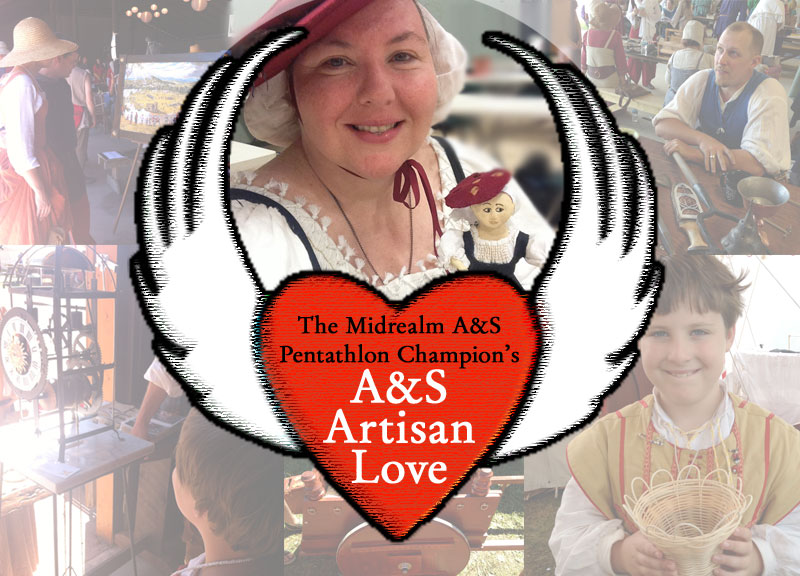
This week I was VERY honored to have been included as a featured artisan on Genoveva Von Lubeck's SCA Artisan Love blog! Please check it out (and the articles she wrote on other, very talented Midrealm artisans) here.
Thank you for the wonderful article, Genoveva!
Sunday, May 4, 2014
A Rose, by any other Name...
So, I have finally, officially changed my persona name to something more... Persianish? If I were following period Safavid naming practices I would probably have a Turkish name (but whos' Turkish? The Ottomans? The Turks? It's all a bit confusing...) I played with a few names that had meanings I liked, but in the end did not like how they sounded. The new name is (drum roll...) Asalah al-Hina. Asal means honey in Persian/Farsi, but I didn't think it sounded very feminine. Asalah, actually an Arabic name, means Nobility of descent.
I will mostly be using this name for "official" things, it's on my new SCA card, class handouts, etc., but I'm sure everyone will continue to call me Anabel, which I really like. It's just not correct for a Safavid woman, so Asalah it is!
Thursday, April 24, 2014
Switching gears... new project, new documentation
So this year I decided to take a little break from henna research and focus more on my garb and garb accessories. In particular I have been trying to find correct Persian shoes. No one seems to be making them, so I decided "why not make them myself?" making leather shoes seemed very daunting to me, but fabric boot? No problem! Ok... not so simple, but very doable.
I chose these buskins to recreate, found in Women's Clothing of the Near and Middle East by Jennifer Scarce.
The first pair I made turned out great, though a little too big.
The second pair was reworked to fit better, and is fully documented (to the best of my current abilities) and the documentation can be found HERE. These boots are being entered in the Pentemere Regional A & S Faire this weekend... wish me luck!
UPDATE!!!
My boot project received a First Place at the Pentemere Regional Arts & Science faire and will be entered in the Midrealm Kingdom A & S faire May 24th!
I chose these buskins to recreate, found in Women's Clothing of the Near and Middle East by Jennifer Scarce.
The first pair I made turned out great, though a little too big.
The second pair was reworked to fit better, and is fully documented (to the best of my current abilities) and the documentation can be found HERE. These boots are being entered in the Pentemere Regional A & S Faire this weekend... wish me luck!
UPDATE!!!
My boot project received a First Place at the Pentemere Regional Arts & Science faire and will be entered in the Midrealm Kingdom A & S faire May 24th!
Saturday, June 1, 2013
A&S Project: Henna from Plant to Paste
This year's A&S project dealt with growing my own henna plant (VERY special thanks to Sir Donas/Tommy Roberts who is really growing the plant as he has better space for it in his house) and creating paste from its leaves. I dried and ground the leaves, used ingredients (water and lemon juice) found in historical henna recipe references, and compared the stain from this paste to paste made from commercially produced henna powder.
Last year my goal was to qualify to go to Kingdom A&S (receive an 1st or 2nd at Regional... I received a 2nd at Regional and went on to receive a 1st at Kingdom). This year's goal was to do a little better, upping my scores in the creativity category as well as qualify for Kingdom and placing well. I received a 1st place at both Regional and Kingdom level A&S.
As great as it is to place well and receive high scores for my project, the most exciting part for me is getting to share my art and my knowledge, as well as learn something new in the process. This year at Regional I learned the I was using the wrong type of mortar and pestle to achieve as fine a grind as i was looking for. I was told I needed an unglazed porcelain mortar. I then ordered one on-line in order to update my documentation before Kingdom A&S. Unfortunately it was back-ordered and did not arrive in time. However, while walking past the merchants on the way to the judges and entrants meeting at the event I found just type of mortar I needed (Much thanks to Duchess Rebekah!). I just happened to have some extra ground henna leaves and reground them in the porcelain mortar. I was so excited to find how easily the leaves ground to a very fine, lush green powder!
Here is the link to the project documentation. Plant to Paste
Last year my goal was to qualify to go to Kingdom A&S (receive an 1st or 2nd at Regional... I received a 2nd at Regional and went on to receive a 1st at Kingdom). This year's goal was to do a little better, upping my scores in the creativity category as well as qualify for Kingdom and placing well. I received a 1st place at both Regional and Kingdom level A&S.
As great as it is to place well and receive high scores for my project, the most exciting part for me is getting to share my art and my knowledge, as well as learn something new in the process. This year at Regional I learned the I was using the wrong type of mortar and pestle to achieve as fine a grind as i was looking for. I was told I needed an unglazed porcelain mortar. I then ordered one on-line in order to update my documentation before Kingdom A&S. Unfortunately it was back-ordered and did not arrive in time. However, while walking past the merchants on the way to the judges and entrants meeting at the event I found just type of mortar I needed (Much thanks to Duchess Rebekah!). I just happened to have some extra ground henna leaves and reground them in the porcelain mortar. I was so excited to find how easily the leaves ground to a very fine, lush green powder!
Here is the link to the project documentation. Plant to Paste
Sunday, March 10, 2013
Branching out...
Though this blog was originally created to document my henna research and journey in the SCA, I have decided to add my research and projects in Persian studies as well. Along with research henna in the medieval period, I am working to develop my persona and garb from Safavid Iran.
While I have been working on creating garb appropriate to the period for several years, I feel I am just now really getting into the "good stuff"... creating a full outfit, using more appropriate fabrics, and adding the accessories such as head wear, jewelry, and footwear.
My next two projects will be dealing with head wear, specifically braid casings a veils, and creating a prototype of a period pouch.
More info and pictures to come...
While I have been working on creating garb appropriate to the period for several years, I feel I am just now really getting into the "good stuff"... creating a full outfit, using more appropriate fabrics, and adding the accessories such as head wear, jewelry, and footwear.
My next two projects will be dealing with head wear, specifically braid casings a veils, and creating a prototype of a period pouch.
More info and pictures to come...
Subscribe to:
Posts (Atom)